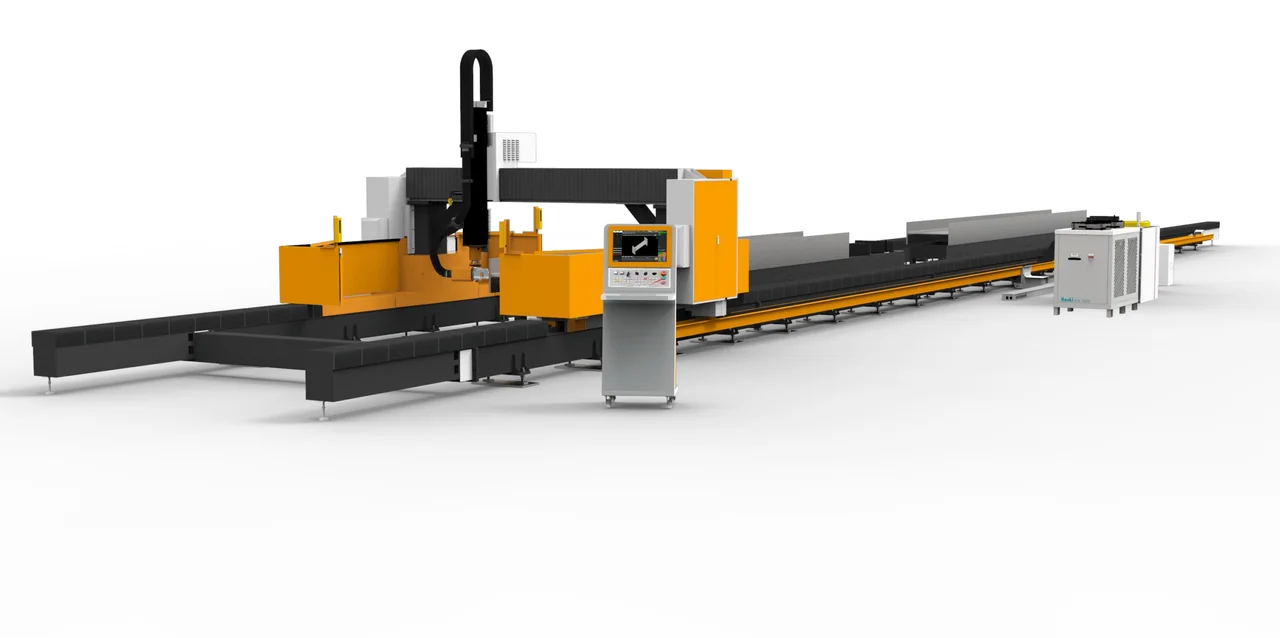
What a Structural Steel Profiler Does
In a steel fabrication shop the profiler is the machine that turns a 3D model into a ready-to-fit member. It cuts the cope at a beam-to-beam connection, the notch where a channel crosses, the holes for bolted connections and the bevel for the weld — usually without re-clamping the member.
The work it replaces is familiar: marking by hand, cutting with a torch, grinding the cope to fit, then drilling separately. Doing all of it in one setup is what makes the joint repeatable.
Beam Coping Robot vs H-Beam Cutting Center
A beam coping robot is a robotic plasma or laser cell with a rotating arm or a moving gantry; it follows the joint geometry and is flexible across sections. An H-beam cutting center is built around a fixed section family and a fixed set of cuts; it is faster per piece at high volume but less flexible on complex connections.
Shops with a steady mix of standard connections often run a cutting center; shops with varied connections, copes and 3D geometry run a profiler or a robotic coping cell. Some run both, splitting work by connection type.
3D Profiling: Copes, Holes and Marks in One Setup
Three operations are usually combined on a profiler: cutting the cope or notch, drilling or marking holes, and marking the member ID or assembly code. Combining them removes the second handling pass and the risk of a part being drilled to the wrong drawing revision.
Software is the enabler: DSTV or STEP files from Tekla, SDS2 or Advance Steel carry the geometry and the marks, so the machine works from the model rather than from a 2D drawing.
Plasma-Beam Profiler vs Drill Line
A drill line drills holes quickly and accurately but cannot cut copes or bevels. A plasma-beam profiler cuts copes, bevels and holes in one setup but is not a dedicated high-speed drill. The split is usually by connection type: hole-heavy standard work on the drill line, connection geometry on the profiler.
Which PCL Machine Fits Your Work
- Beam coping robot (8-axis plasma) — copes, holes and 3D profiles on structural beams.
- H-beam cutting center (H-series) — high-volume cutting, drilling and marking of H-beams.
- Large-format gantry laser — plate and profile cutting when the work is flat rather than 3D.
- Pipe profiler — the same 3D problem on pipe and tube.
Send a drawing of the connection and the section sizes; our engineers will tell you whether a coping robot, a cutting center or a plate machine is the right fit.
FAQ
What is a structural steel profiler?
A structural steel profiler cuts the 3D end shapes on beams, channels and box sections — copes, notches, holes and bevels — so members fit together without manual marking and grinding.
What is a beam coping robot?
A beam coping robot is a robotic plasma or laser cell that cuts copes and 3D profiles on structural beams. It is the automation-heavy version of a beam coping machine.
How is a profiler different from an H-beam cutting center?
A cutting center is built around one section family and repeats a fixed set of cuts at high volume. A profiler is built around the 3D geometry of the joint and handles copes, holes and marks in one setup.
Plasma-beam profiler or drill line?
A drill line drills holes fast but cannot cut copes or bevels. A plasma-beam profiler cuts copes, bevels and holes in one setup. Many shops run both: drill line for hole-heavy work, profiler for connection geometry.
Can a profiler cut both beams and pipe?
Some robotic coping cells handle CHS pipe and SHS/RHS box sections in one machine; others are beam-only. The working envelope decides it, not the software.
What software drives a structural steel profiler?
Most cells read DSTV or STEP files from Tekla, SDS2 or Advance Steel, and generate the tool path from the 3D model rather than from a 2D drawing.