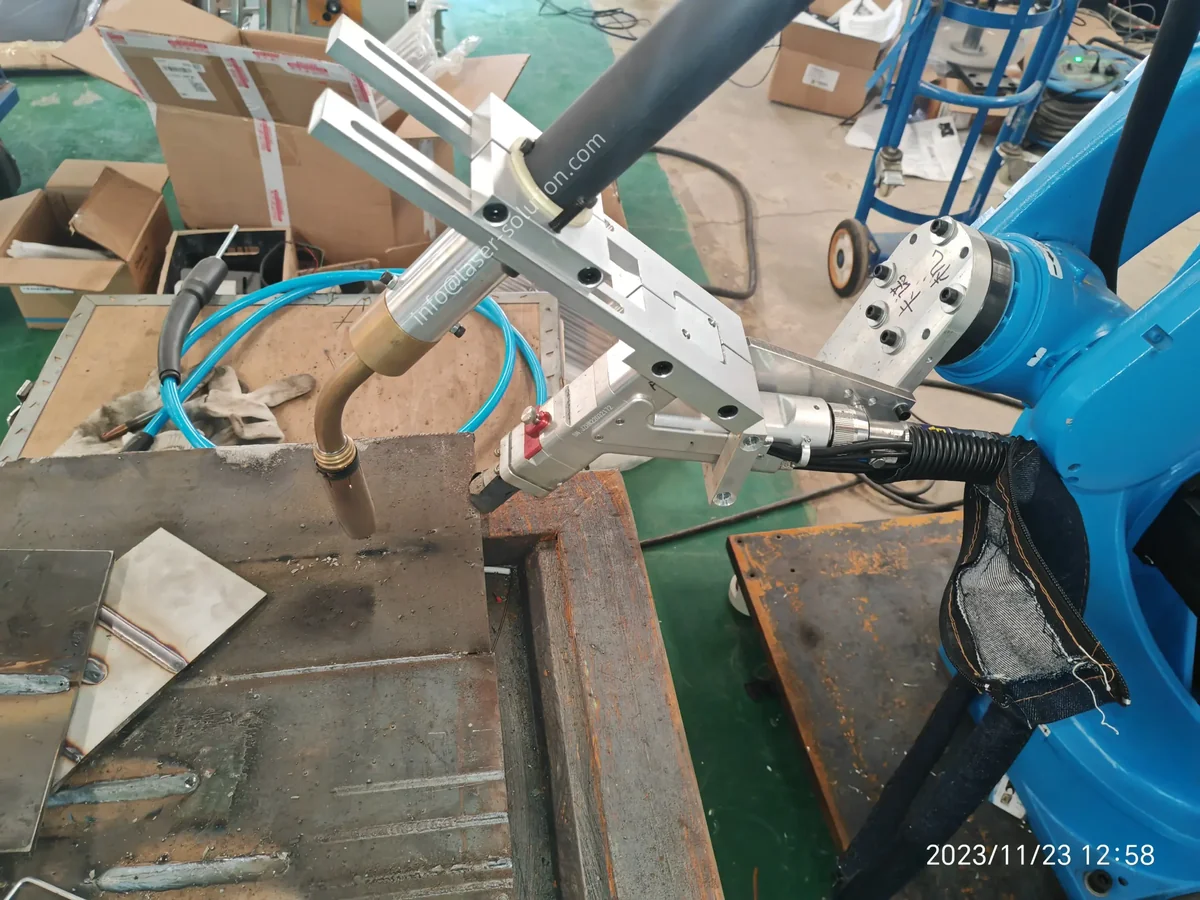
A 3D robotic laser welding machine combines three-dimensional robotic motion with focused-beam laser welding. The robotic arm positions the laser head with high precision across X, Y and Z axes, while the concentrated laser beam melts and joins metal with a tightly controlled, minimal heat-affected zone.
Because the robot moves freely in three dimensions, the system welds complex and three-dimensional shapes that fixed-axis equipment can't reach — a common requirement in automotive, aerospace and electronics manufacturing where components carry intricate geometry.
MIG + Laser Welding Tools Together
The tool head can switch between MIG and laser welding, with optional positioner and rail systems extending reach across larger workpieces or multiple welding stations.
Why Laser Welding
Laser welding runs at high speed with minimal heat input, reducing distortion and thermal damage while producing cleaner, more consistent welds that need less post-processing. Once programmed, the system adapts quickly between welding tasks, cutting changeover time between production runs and letting operators monitor the process remotely.
Cell vs Cobot vs Manual Welding
A fenced robot cell suits high-volume, repeatable joints; a cobot suits lower volume and mixed parts; manual welding remains flexible but depends on operator skill. The deciding factors are batch size, joint access and weld quality tolerance. PCL configures the cell with positioner, rail and tooling per part family.
Typical Applications
Aimed at shops facing a shortage of certified welders, or running repetitive joint geometry where manual welding quality varies operator to operator.
- Structural beam and column sub-assembly welding
- Shipyard block and panel joining
- Heavy equipment frame and chassis welding
- Repetitive batch production requiring consistent weld quality